
This is Part 2 of our Agentic Commerce series. In this installment, we move beyond the “what” and “why” to explore the “how.” We are diving deep into the technical infrastructure required to win in a world where AI agents don’t just recommend products, they negotiate, transact, and complete the entire commerce journey on behalf of humans.
If you haven’t read the first part where I introduce this topic and go through the foundational concepts, please read it here: Part 1 Article.
The agentic economy is moving fast. To ensure you’re the first to know about industry shifts, technical breakthroughs, or exclusive discounts on our ecommerce services, subscribe to my newsletter below.
In this article, we’ll be discussing the technical architecture of agentic commerce, what you need to get right today to win tomorrow. When agentic commerce achieves full autonomy, agents will act on behalf of people via Agent-to-Agent (A2A) protocols.
Since we’re talking commerce, you might be wondering if this includes payments. The answer is yes. Ultimately, agents will automate the entire journey: negotiating on your behalf with other agents and completing transactions without you doing anything.
To be a leading player in this marketplace, there are several critical areas you must master: Data Architecture, Payment Protocols, Brand-Owned Agents, and Organisational Skills.
Agentic commerce is powered by data; specifically, how it is collected, structured, accessed, and trusted. Adapting your data strategy is no longer optional; it is a prerequisite for survival.
For years, businesses optimised for Search Engine Optimisation to rank for human eyes. Agentic commerce introduces a new model: GXO (Generative Experience Optimisation).
GXO means optimising for AI agents that increasingly take action for the customer. These agents take in vast amounts of information to provide recommendations. Their effectiveness hinges on the quality and accessibility of the data they consume. This necessitates a move toward AI-ready content operations, where digital assets are not only authoritative but also semantically rich and machine-readable. Think of it as preparing your digital storefront for intelligent machines that need to understand every small details of your offerings.
A solid data foundation must be clean, structured, and machine-readable. This involves:
– Structured Data: Moving beyond unstructured text to well-defined data schemas (like Schema.org) that AI agents can easily parse.
– Enriched Content: Augmenting product descriptions with detailed attributes, high-quality imagery, and rich metadata.
– Optimised Taxonomies: Developing consistent content taxonomies that facilitate natural-language processing (NLP) and agentic discovery.
Data architectures must prioritise interoperability through robust APIs and standardised protocols. The goal is seamless, real-time data exchange between your systems and a multitude of AI agents, regardless of their underlying platforms.
Your product catalog is no longer just a list; it’s the primary interface for AI agents. This requires investment in:
1. Comprehensive Catalogs: Including extensive attributes and detailed specifications beyond names and prices.
2. Semantic Enrichment: Attaching tags that allow agents to understand not just what a product is, but how it relates to customer needs and specific use cases.
3. Metadata for Context: Providing context on usage, benefits, and customer reviews to enable highly personalised recommendations.
The Model Context Protocol (MCP) is a critical open standard designed to facilitate secure, two-way connections between data sources and AI tools. Aligning with MCP means:
– Standardised Formats: Adopting common data models consumable by diverse agents.
– API-First Approach: Exposing data through secure, industry-standard APIs.
– Context Availability: Ensuring data is interconnected, allowing agents to pull historical data, real-time inventory, and customer preferences.
In an agentic world, the trustworthiness of your data is your moat.
– Clean & Structured: Reduces the likelihood of incorrect agent decisions.
– Connected: Enables agents to draw insights by linking data points.
– Permissioned: Underpins governance and privacy. Businesses must control which agents can access what data, ensuring compliance with regulations like PCI DSS v4.0.1.
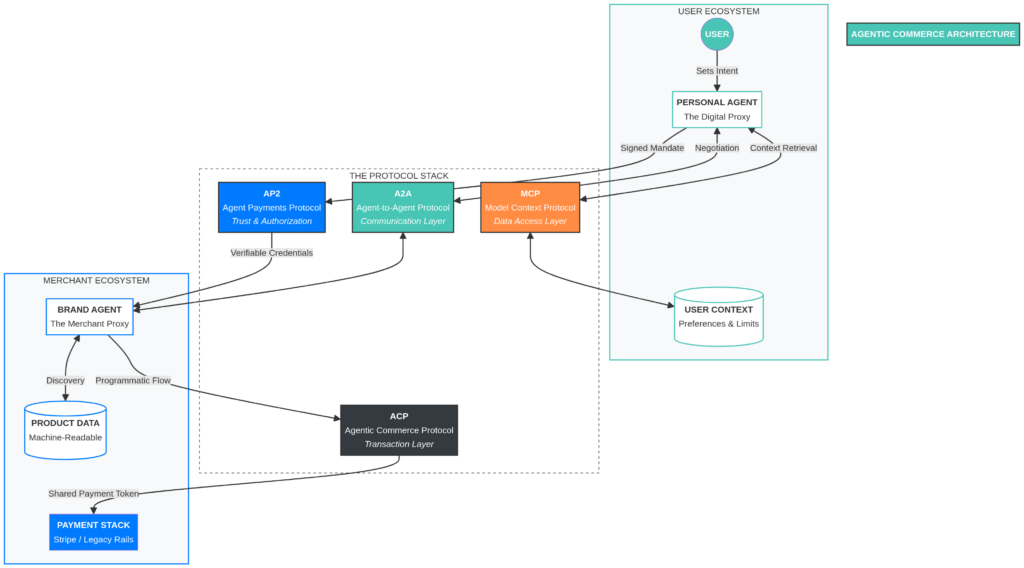
In its ultimate form, agentic commerce promises full autonomy, including paying for orders on your behalf. As the marketplace matures, a new generation of payment protocols is emerging to govern these machine-to-machine transactions.
Several initiatives are shaping the standards for the agentic economy. These are not mutually exclusive; they represent complementary layers of a new payment stack.
| Protocol / Initiative | Lead Developers | Core Focus | Key Characteristics |
|---|---|---|---|
| Agentic Commerce Protocol (ACP) | Stripe & OpenAI | Merchant checkout integration | Open standard enabling AI agents to interact with existing e-commerce checkouts via Shared Payment Tokens. |
| Agent Payments Protocol (AP2) | Trust, authorisation, and verifiable intent | Uses Verifiable Digital Credentials (VDCs) to create a cryptographic audit trail and "Intent Mandates." | |
| x402 Protocol | Coinbase | Internet-native micropayments | Leverages the HTTP 402 "Payment Required" status for low-friction stablecoin payments. |
| Mastercard Agent Pay | Mastercard | Secure tokenisation | Provides a framework for recognising trusted AI agents and tokenising transactions to protect sensitive data. |
| Visa Intelligent Commerce | Visa | Personalised and secure delegation | Empowers AI agents to pay on behalf of consumers according to pre-selected preferences and limits. |
At a conceptual level, these protocols establish a “contractual conversation” between the user, agent, merchant, and network:
1. Delegation & Constraints: The user grants authority, setting limits and budgets. In Google’s AP2, this is a cryptographically signed “Intent Mandate.”
2. Discovery & Negotiation: The agent autonomously finds products and may negotiate terms.
3. Secure Authorisation: The agent presents a proposed transaction. AP2’s “Cart Mandate” provides non-repudiable proof of consent.
4. Execution & Settlement: Payment is executed using secure, tokenised credentials. Sensitive info is never exposed to the agent.
5. Auditing: Every step is logged for dispute resolution and fraud analysis.
While making your data agent-ready is foundational, a truly competitive strategy extends to launching your own brand-owned agents.
– Personalised AI Experiences: Delivering bespoke interactions. For example, Lowe’s “Mylow” provides personalised home improvement guidance, assisting with project inspiration and in-store item location.
– Interoperability (M2M): The future involves Merchant-to-Merchant (M2M) interactions. Success hinges on your agent being able to connect and communicate within a broader ecosystem using the Agent-to-Agent (A2A) Protocol.
– Brand Value Preservation: Embedding your brand’s voice and expertise directly into the automated journey ensures consistency and control.
– Ecosystem Connectivity: Consumers will rely on personal agents to manage needs across platforms. Retailers must create agent-ready sites to ensure they aren’t disintermediated.
Developed by Google and now under the Linux Foundation, the A2A Protocol provides a common language for agents. Its architecture includes:
– Canonical Data Model: Core data structures using Protocol Buffers.
– Abstract Operations: Fundamental behaviors (SendMessage, GetTask) independent of transport.
– Protocol Bindings: Mappings to JSON-RPC, gRPC, and HTTP/REST.
Key Concepts in A2A:
– Agent Card: A JSON metadata document detailing an agent’s identity and skills.
– Task: The stateful unit of work with a defined lifecycle.
– Opaque Execution: Agents collaborate based on declared capabilities without needing to share internal states.
– Walmart (Sparky & Wally): “Sparky” is a customer-facing shopping assistant, while “Wally” aids internal merchant operations. Walmart’s partnership with OpenAI enables “AI-first” shopping directly via ChatGPT.
– Shopify: Developing infrastructure for Cross-Merchant Cart Building, allowing agents to browse and consolidate carts across different Shopify stores.
– Perplexity (Buy with Pro): A search engine evolved into a commerce agent that handles selection, shipping, and execution of transactions.
– AdTech (AdCP): A consortium including Yahoo! and PubMatic launched the Agentic Advertising Protocol for programmatic ad space negotiation by agents.
Agentic commerce represents a fundamental shift in operating models. It requires a proactive approach to talent, restructuring, and investment.
Businesses must move from human-centric, siloed workflows to AI-first approaches where humans oversee and steer agentic systems. The “Agentic Organisation” is a network of empowered, outcome-aligned teams working with AI agents to create value.
Investment in AI certification and literacy is non-negotiable. Key competencies include:
– AI Literacy for Non-Technical Teams: Understanding AI’s impact on the business.
– Data Engineering & Knowledge Architecture: Building the foundations for agents.
– Prompt/System Design: Crafting effective instructions for agentic workflows.
– Governance & Ethics: Ensuring responsible deployment and regulatory adherence.
Innovation requires an environment where teams can test solutions without operational disruption.
– Safe Sandboxes: Secure environments for testing agent configurations.
– Iterative Development: Embracing the “Experiment, Evaluate, Deploy, Repeat” mindset.
– Data-Driven Decision Making: Basing strategy on empirical evidence from AI pilots.
The consequences of doing nothing are severe:
1. Widening Skills Gaps: An inability to manage or innovate with autonomous systems.
2. Loss of Competitive Advantage: Early adopters will gain market share through hyper-personalisation and efficiency.
3. Increased Operational Risk: Compliance failures and security vulnerabilities due to lack of oversight.
To navigate this revolution, I recommend the following roadmap:
1. Prioritise AI Literacy: Implement upskilling across all levels of the organisation.
2. Redefine Structures: Move toward flat networks of cross-functional agentic teams.
3. Invest in Data Foundations: Recognise proprietary data as your key differentiator.
4. Balance Innovation with Safety: Ensure ethics and risk management are integral to every AI initiative.
5. Strategic Vendor Management: Build internal capabilities to avoid over-reliance on external platforms.
Agentic commerce is no longer a concept; it is happening now. The businesses that succeed will be those that accept this revolution and actively shape its direction.
We use cookies to improve your experience on our site. By using our site, you consent to cookies.
Manage your cookie preferences below:
Essential cookies enable basic functions and are necessary for the proper function of the website.
You can find more information in our Cookie Policy and Privacy Policy.